Setting the Scene Setting the Scene
Israel is a special nation. Jesus states that "salvation
is from the Jews" (John 4:22). This special status exists
as a result of a promise that God made to Abram:
The blessings associated with this special status are dependent upon
the nation's willingness to live by God's commandments. Moses clarified
this issue shortly after the birth of the nation:
The nation of Israel was under strict instructions to completely avoid
idol worship. God's instructions through Moses makes this clear:
Israel ignored this warning. The Old Testament prophets state that Israel
was noted for her idolatry. In some instances, Israel's sin involved sacrificing
children to the pagan gods that they had adopted:
Israel's disobedience was so great that God punished them by removing
their government, they were warned of this event by Ezekiel:
Nebuchadnezzar's dream pointed to Israel's domination by foreign powers,
and the eventual restoration of the kingdom when the nations of the world
will accept Israel as their capital (Micah 4:2).
The prophet Daniel provides information relating to one of the first
"ruinings" of Israel:
Nebuchadnezzar's Dream
Nebuchadnezzar, the king of Babylon dreamt of
an image that disturbed him (Daniel 2:3). He demanded that his magicians
explain the significance of the dream. They asked the king to tell them
the dream so that they could decipher its meaning. To keep the magicians
honest, the king demanded that they should declare both the dream and its
meaning. He used the threat of death to encourage success. God's prophet
Daniel was able to meet the king's challenge. He made it clear that God's
help made this possible:
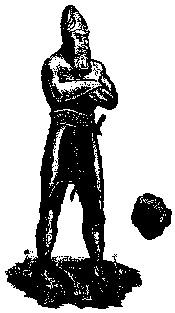
Daniel proceeds by describing exactly the image in the king's dream. He describes a man who was "awesome in appearance." Daniel explained
that the parts of the man's body represent world powers:
 | | | | |
"You looked, O king, and there before you stood a large statue... The head of the statue was made of pure gold, its chest and arms of silver, its belly and thighs of bronze, its legs of iron, its feet partly of iron and partly of baked clay. While you were watching, a rock was cut out, but not by human hands. It struck the statue on its feet of iron and clay and smashed them. Then the iron, the clay, the bronze, the silver and the gold were broken to pieces at the same time and became like chaff on a threshing floor in the summer. The wind swept them away without leaving a trace. But the rock that struck the statue became a huge mountain and filled the whole earth. |
Daniel 2:31-35, NIV |
|  | |  | |
|  |
Nebuchadnezzar now knew that the dream's purpose was to outline future
events. Having described the dream, Daniel explained its meaning:
| | | | "You are that head of gold. After you, another kingdom will rise, inferior to yours. Next, a third kingdom, one of bronze, will rule over the whole earth. Finally, there will be a fourth kingdom, strong as iron -- for iron breaks and smashes everything -- and as iron breaks things to pieces, so it will crush and break all the others. Just as you saw that the feet and toes were partly of baked clay and partly of iron, so this will be a divided kingdom; yet it will have some of the strength of iron in it... "In the time of those kings, the God of heaven will set up a kingdom that will never be destroyed... It will crush all those kingdoms and bring them to an end, but it will itself endure forever." This is the meaning of the vision of the rock cut out of a mountain... that broke the iron, the bronze, the clay, the silver and the gold to pieces. | Daniel 2:38-46, NIV |
| | | | |
Summary: Explanation of the image
| Daniel's Statements | Reference |
|---|
| The purpose of the image is to reveal the future. | Dan. 2:28 |
| The image represents four kingdoms. | Dan. 2:37-40 |
| The first kingdom is Babylon. | Dan. 2:37 |
| A procession of conquering powers to appear. | Dan. 2:39 |
| The second kingdom is the Median and Persian empire. | Dan.5:28,31 |
| The toes of the image represent a divided kingdom. | Dan. 2:41-42 |
| The smashed image represents the dismissal of human kingdoms. | Dan. 2:44 |
| The rock that becomes a mountain represents God's kingdom. | Dan. 2:44-45 |
The image portrays the kingdoms that will exist from the time of Nebuchadnezzar
to the kingdom of God. Nebuchadnezzar's image does not provide a full explanation.
Daniel had a dream (7:1-3) which sheds more light on the subject. In his
dream, the same succession of kingdoms are represented by animals -- the
lion, the bear, the leopard and a terrible beast:
Daniel's writings are highly symbolic. Other Scripture passages shed
light on some of the symbology used. Isaiah uses the sea to represent
wicked people:
Daniel asked (7:15-18) for the dream's meaning and was told
that the four beasts represented four kingdoms that would rule
until God's Kingdom appeared. These details show the link
between Daniel's dream of the four beasts and Nebuchadnezzar's image.
The Lion
The first beast to come out of the sea was a lion, which had the wings
of an eagle. Once again, a knowledge of other Bible passages helps to get
to the meaning of the symbology, in this case, Jeremiah helps:
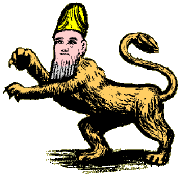
Linking the lion to Babylon to identify the first kingdom further reinforces
the stand that the two dreams speak the same message. Note that the lion
was tamed in that it had its wings plucked and it was given the heart of
a man. This aligns with Daniel's report relating to Nebuchadnezzar and
his humbling by God (Daniel 4).
The Bear
Daniel writes that the next empire was the bear power:
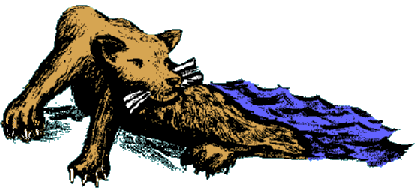
Aligning this beast with the second segment of the statue (the chest
and arms of silver) shows that the bear represents the Medes and Persians.
The Four Headed Leopard
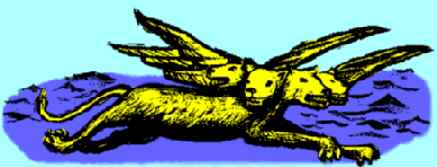
The leopard represents the power that conquered the Medes and Persians.
This was achieved by Alexander the Great. Other information provided by
Daniel mentions Grecia by name -- reference will be made to this shortly.
The Terrifying and Frightening Beast
This power is not mentioned by name, but it is common knowledge that
the Roman power overran the Greek Empire.

Why align the beasts with the king's dream?
The table below illustrates the parallels between the two symbols.
| Nebuchadnezzar's image | Daniel's four beasts |
|---|
"Finally, there will be a fourth kingdom." Dan 2:38 |
"The four great beasts are four kingdoms that will arise from the earth." Dan 7:17 |
The first kingdom (the head of gold) represents Babylon. Dan 2:38 |
The lion represents both Babylon and the first kingdom. Jer 50:17, Dan 7:4 |
The four kingdoms yield to the kingdom of God. Dan 2:44 |
The four kingdoms are defeated by God's saints. Dan 7:17 |
Nebuchadnezzar was civilised. Dan 4:28-37 |
The lion was civilised. Dan 7:4 |
The fourth kingdom is represented by iron. Dan 2:40 |
The fourth terrible beast had iron teeth. Dan 7:7-8 |
| As iron breaks things to pieces, so it will crush and break all others. Dan 2:40 |
The fourth beast -- terrifying and frightening and very powerful... it crushed and devoured its victims. Dan 7:7 |
Logic dictates that the power represented by the leopard is the power
that conquered the Medes and Persians. It was the Greeks that achieved
this under the leadership of Alexander the Great.
We can support this conclusion by considering yet another set of symbols.
They shed light on the progression of the empires that lead up to the point
where the kingdoms of men become the Kingdom of God. These symbols are
the ram and the goat. In chapter 8, Daniel uses them to represent two antagonistic
powers.
The complexity of the multiple symbols is reduced as a result of the
parallels that exist and Daniel's naming of them in most cases. The table
below provides an illustration of the harmony and explanation:
| Statue parts (Dan 2) |
Beast (Dan 7) |
Ram/Goat (Dan 8) |
Meaning |
|---|
| Chest and arms of silver. Medes and Persians conquered Babylon. (Dan 5:28) |
Bear -- One side higher than the other. (Dan 7:5) |
Ram -- One horn higher than the other. (Dan 8:3) |
"The two-horned ram that you saw represents the kings of Media and Persia." |
| Belly and thighs of bronze. |
Leopard -- Four heads and four wings. (Dan 7:6) |
Goat -- Four horns (appear after the first horn broken off). (Dan 8:8) |
"The shaggy goat is the king of Greece and the large horn between his eyes is the first king." |
Aligning Daniel's prophecies with history
Daniel's prophecies are remarkable in that they have accurately predicted
that the Babylonian Empire would be consumed by the Medes and Persians, the
Medes and Persians would be overrun by the Greeks and the Greeks would be
conquered by the Romans. These facts are commonly reported in Encyclopaedias:
As the Bible predicted, the Medes and Persians were overtaken by the
Greeks:
Once again as predicted, the Macedonians were conquered by the Romans:
Many empires have existed throughout history, some parallel to the existence
of the powers described by Daniel. Why are these four singled out for mention?
These four powers are special in that they have invaded Israel.
Hosea warns Israel of God's anger towards them because of their idolatry.
He complains that He fed Israel, and when they were satisfied,
they became proud and forgot Him. Israel is warned that the attack upon
them will be like the attack of the lion, the leopard and the bear. The
animals mentioned by Hosea are used by Daniel to typify the powers that
invaded Israel as punishment for their idolatry.
If the image is to stand erect, enabling God to strike it and destroy
it to make way for His everlasting Kingdom, this power that embodies the
spirit of the ancient Empires must appear in modern times.
The Beast in Revelation 13
The book of Revelation describes a beast that is a mixture of
four beasts. The beasts are identical to those used by Daniel.
There are several parallels between Daniel 7 and Revelation 13:
| Daniel 7 | Revelation 13 |
|---|
| The beast has ten horns. Dan 7:7 |
The beast has ten horns. Rev 13:1 |
| It speaks great words against God. Dan 7:25 |
It speaks great things and blasphemies. Rev 13:5 |
| One of its horns makes war with the saints and prevails against them. Dan 7:21 |
It makes war with the saints and overcomes them. Rev 13:7 |
| It continues for a time, times and half a time. Dan 7:25 |
Power was given to the beast for 42 months. Rev 13:5 |
The term 'time, times and half a time' may seem a little obscure. Assuming
that 'time' equals 1 year, that 'times' equals 2 years, and that 'half a time'
equals a half year, the total period equals 42 months. There are several
Scripture references that support this interpretation.
Accepting that Daniel's prophecy identifies Babylon, The Medes and Persians
and Greece, logic dictates that the fourth power "The Beast"
must be identified as the Roman power. Weight can be added to this view
by considering this quote:
Consider this in the light of the quote from the Columbia Encyclopaedia
regarding Rome:
| | | | | Ancient Rome was built on east bank of the Tiber... The seven hills of the ancient city are the Palatine... the Capitoline... the Quirinal, Viminal, Esquiline, Caelian and Aventine... |
| | | | |
Even though the ancient empires including Rome have vanished, they have
had a strong influence on subsequent societies. Immediately preceding Jesus'
return, many nations will mimic the empires mentioned by Daniel in that
they will invade the land of Israel:
Zechariah describes the Lord fighting against the nations that attempt
to destroy Israel. Daniel describes the use of a stone to destroy
Nebuchadnezzar's image. The stone is Jesus -- consider the following passages:
Paul's letter to the Corinthians shows that Jesus' return also involves
the resurrection of the dead and their judgement together with the living.
His comments show that Jesus' work is to develop the peoples of the world
to the extent that "God may be all in all" (1 Cor 15:28)
meaning that God will be all things to all people:
Iron and Clay
After the Roman empire there was no other that dominated the world. The
feet of iron and clay shows the state of the nations from the end of the
last empire: some iron-strong, others weak, each not mixing with the others.
While some talk about giving names to each of the toes, (for example,
the ten toes represent the following ten nations from the Economic Community:
France, Germany, etc...), there is no evidence that this is the case, and it
is based on assumptions.
So it is while the nations of the world is in this state that the rock
will come, and shake the whole world.
Conclusion
We've taken two pictures, one from Daniel, the other from Revelation, to
show that the Bible does have a common, consistent theme. Both the New and
Old Testaments are of value to us today.
If we base a doctrine, or belief, solely on one verse of Scripture, we
must be very careful to make sure that is consistent with what is written
in both the Old and New Testaments. Because when two verses appear to
contradict themselves, we must re-evaluate our uninspired understanding:
the inspired Bible does not contradict itself.
A final quote from the prophet Isaiah:
|
|